
Platform — Authority
Authority is a statement, not a role.
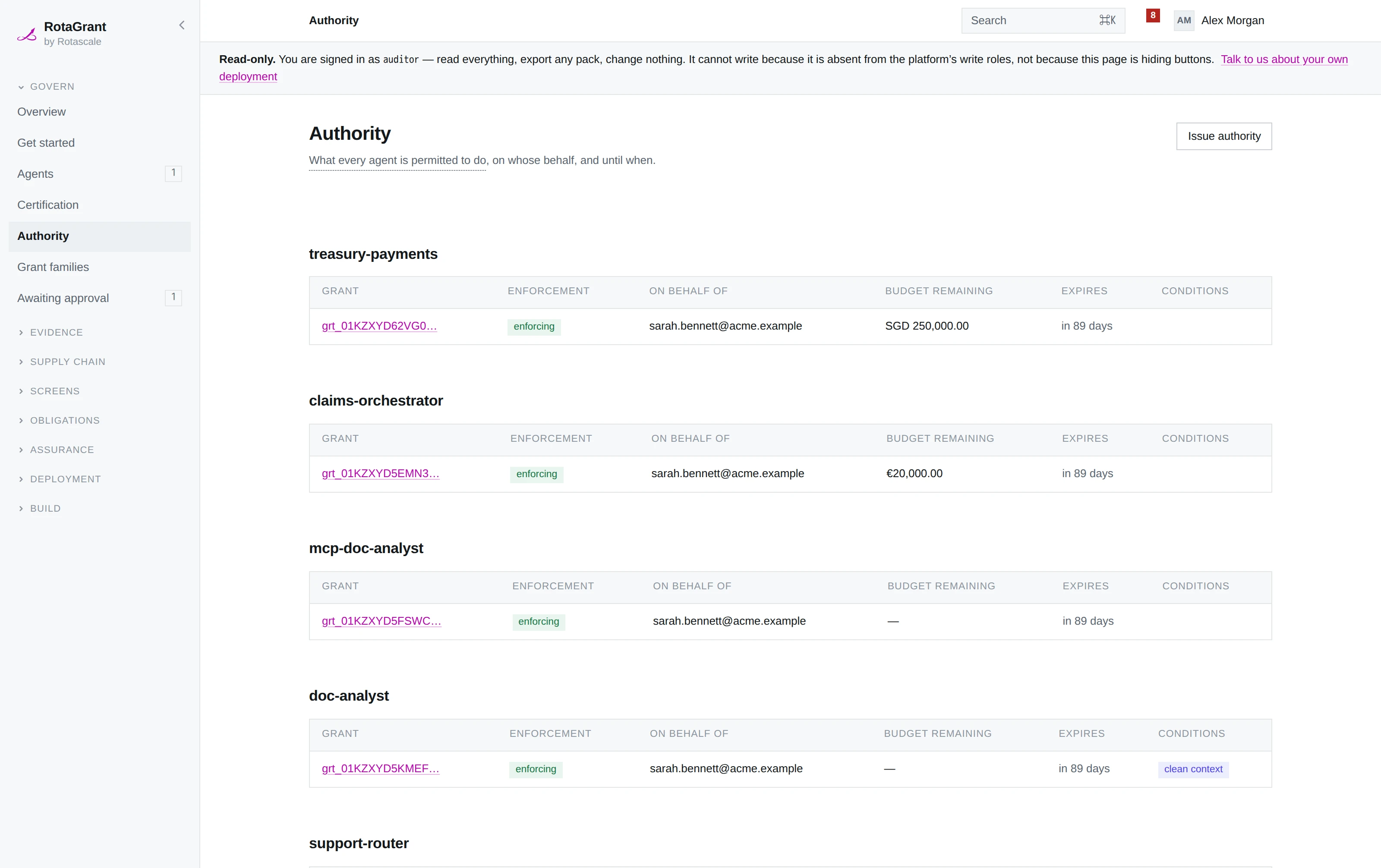
A grant says what one named agent may do, up to what value, until when, and under what conditions — signed for by an accountable human. A role says who someone is. A grant says what they may do, bounded and expiring.
Four rules that hold whatever the tree looks like
Nothing unowned holds power
An agent without a named accountable owner cannot be granted anything. The refusal is the control — an agent nobody answers for cannot be given authority by accident.
observed →Delegation subdivides, never multiplies
A delegated grant cannot exceed its parent on scope, window, budget, conditions or enforcement mode. Spending against a child debits every ancestor, so a tree of grants cannot sum to more than its root — which is the property that makes an orchestrator handing work to a specialist safe rather than a multiplier.
observed →Revocation reaches the whole tree
Revoking a grant revokes everything delegated from it. And the question that always follows — was anything allowed afterwards — is one the platform answers, rather than leaving you to trust that it wasn't.
observed →High-value authority takes two people
A grant above a threshold the regime sets is issued
pending_approval and does nothing until a second named
person signs it. The threshold is the regime's, not a preference.
The refusal does not depend on the agent's cooperation
Every refusal described so far requires the agent to ask. A compromised or badly written agent that simply calls the payment API directly is ungoverned, and a governance layer that only works against well-behaved software is advice rather than enforcement.
- A capability token
- When a grant names a resource, an allowed decision mints a short-lived token bound to that resource, that action and that amount.
- Verified offline
- The resource checks the signature against a published key. It does not call us, and it refuses a request with no token or an insufficient one — on evidence the agent cannot forge.
- Held, not spent
- Authority for a named resource is held until the resource says what happened. Settled debits the ceiling; released gives it back; and a hold nobody ever resolves expires and is reported as a finding, because an agent that obtained authority with no record of what became of it is worth knowing about.
What this does not do. A resource that never checks the token is still ungoverned. This moves the enforcement point to something the agent does not control; it does not reach systems that have not been instrumented, and no honest description of it says otherwise.