
Platform — Assurance
We attack our own controls, and publish where they fail.
A platform that detects personal identifiers is making a claim about an adversarial world. We test our detectors is effort, and effort is what a vendor asserts about itself. Evidence has a denominator.
Computed live, never stored. A saved grid keeps asserting yesterday's answer about a detector somebody has since changed — which for this artefact is the whole failure mode.
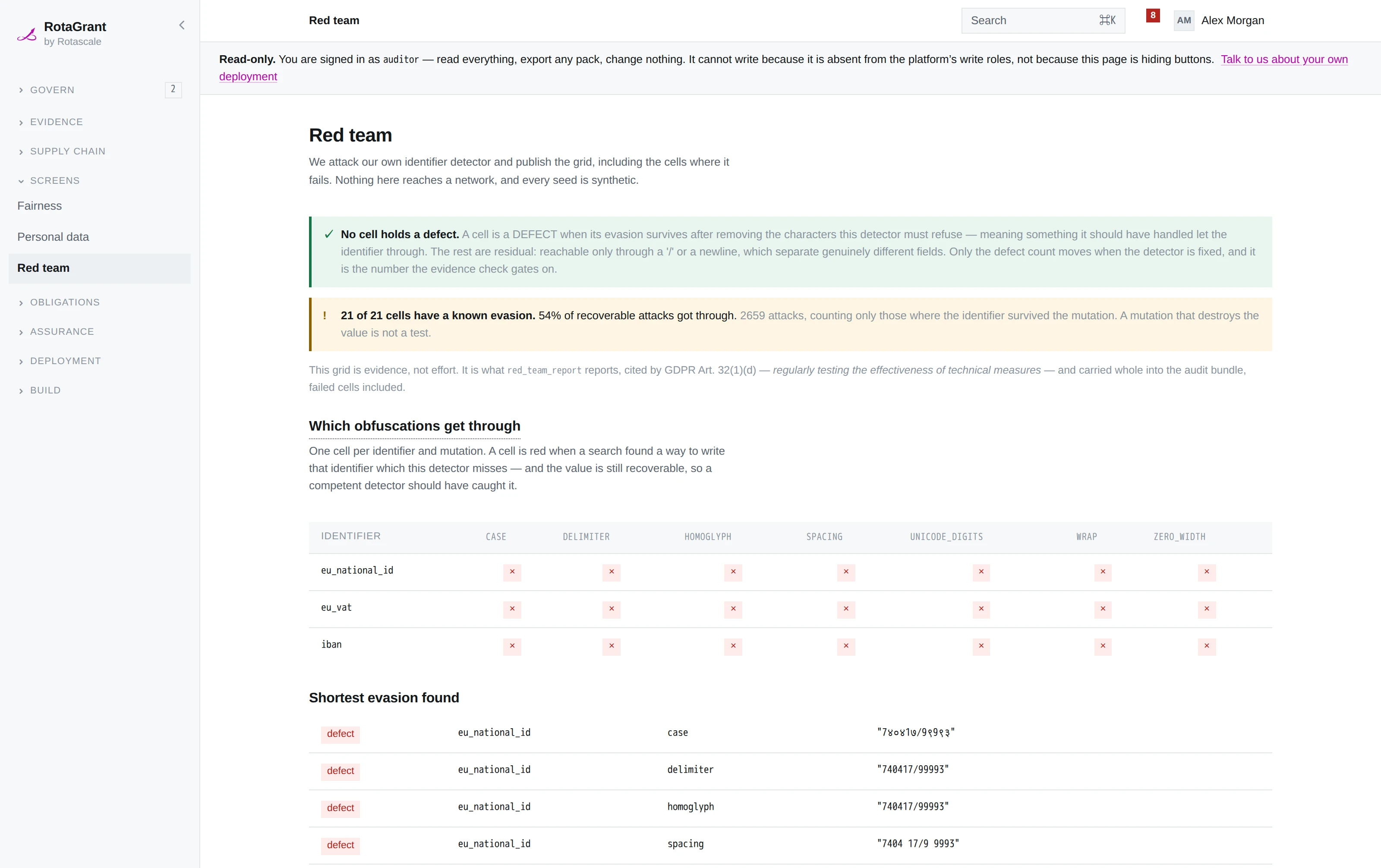
A red cell is not automatically a failure
Most of the grid is reachable only through a / or a newline —
characters that separate genuinely different fields, which a detector must
refuse to treat as internal. Closing those cells would buy the number with
false positives, and a false positive here makes somebody erase evidence
they needed.
- Residual
- Remove the characters the detector must refuse, ask it again, and it finds the identifier. The miss was caused by something it was right to reject.
- Defect
- It still misses. Something it should have handled let the identifier through — and this is the only number a fix moves, so this is the number the evidence gates on.
Two wrong gates preceded this one. Gating on every attack failed let a regime read 100% while all fourteen cells were evadable; gating on every cell evaded would have condemned a detector for refusing a character it is supposed to refuse. Both are recorded in the source, because the next person will reach for one of them.
What the grid changed
The first full run was 21 cells, 21 evaded, 2 defects: a VAT number and a national identifier both got through when written with spaces, which is how both are printed. The fix was not tolerance. It was structure.
Checked, not matched
EU VAT is now recognised per member state at that state's exact length, with the published check digit run for the twelve that have one — each algorithm confirmed against a real registration before it shipped. An algorithm we could not confirm that way is absent rather than guessed, because a wrong checksum produces confident false negatives.
observed →Confidence is a property of the match
Twelve states publish a check digit and fifteen do not, so no single
answer for the family could be true. A German number is
observed and a Cypriot one asserted, in the
same result, and the screen says partly checked.
The noise floor is measured
A generic eleven-digit pattern reported 100% of random strings as national identifiers — order references, phone numbers, timestamps. Three checksummed schemes report 2.3%, and a test measures it so a future scheme cannot quietly restore the old behaviour.
observed →A pack nothing attacks is named
A jurisdiction pack with no synthetic seed is absent from the grid, and its cells are absent from the denominator with it. A denominator that shrinks in silence reads as coverage, so it is stated.
observed →The cost, disclosed. A member state whose scheme is not implemented is no longer detected, and fifteen VAT states are recognised by length alone and reported as asserted rather than observed. Both are stated beside the result rather than absorbed. Every seed is synthetic and checksum-valid; no real identifier is used, stored or transmitted.
What a screen can and cannot settle
The fairness screen compares outcomes across attributes a subject
declared — nothing is inferred, and a decision carrying no
declaration is reported as undisclosed rather than estimated.
A screen that fills gaps by inference is producing a claim about
individuals in order to make a claim about a population.
A clean screen is not proof of fairness and a flagged screen is not proof
of discrimination. Both are grounds for a controlled analysis somebody else
performs, and approval-rate parity ignores how the underlying populations
differ. That belongs in the output rather than in a footnote — for the same
reason every screen listing an observe grant says it refuses
nothing.